
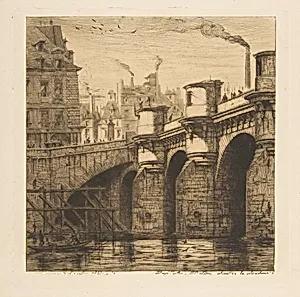
Pont-Neuf, Paris
1853
Medium
Etching and drypoint; seventh state of eleven
Dimensions
Plate: 7 1/4 x 7 3/16 in. (18.4 x 18.3 cm) Sheet: 12 1/2 x 11 5/16 in. (31.8 x 28.7 cm)
Classification
Prints
Department
Drawings and Prints
Museum
Metropolitan Museum of Art, New York, NY
Credit
Gift of Theodore De Witt, 1917
Accession Number
17.22.17
Rights
Public Domain
Tags
Art Historical Context
Charles Meryon's *Pont-Neuf, Paris (1853) captures the iconic oldest bridge spanning the Seine River, a symbol of enduring Parisian architecture since its completion in 1607. As part of Meryon's renowned series *Eaux-Fortes sur Paris*, this etching celebrates the city's Gothic and Renaissance landmarks amid the transformative urban renewal of the 1850s under Baron Haussmann. Meryon, a visionary 19th-century French printmaker influenced by Romanticism, infused works with meticulous detail and atmospheric depth, evoking a nostalgic view of Paris before modernization. Rendered in etching and drypoint—the seventh state of eleven—this print showcases Meryon's masterful technique. Etching creates precise lines through acid corrosion on a metal plate, while drypoint's direct needle scratches produce a soft, velvety burr for rich tonal effects, lending the image a painterly quality rare in prints. Progressive states allowed Meryon to refine details like the bridge's arches and river reflections, heightening drama and texture. Housed in the Metropolitan Museum of Art's Drawings and Prints department (gift of Theodore De Witt, 1917), this work exemplifies the golden age of 19th-century French etching, blending technical innovation with poetic urban portraiture. Visitors will appreciate its intimate scale (plate: 7¼ × 7⅛ in.) and timeless allure of Paris's historic heart.
About the Artist
Charles Meryon · 1821–1868
Charles Meryon, born on November 23, 1821, in Paris, was the illegitimate son of English physician Dr. Charles Lewis Meryon and dancer Pierre-Narcisse Chaspoux (stage name Narcisse Gentil) at the Paris Opéra. His half-sister Fanny, from his mother's prior relationship with Viscount Lowther, remained in contact after their mother's death in 1838. Raised partly outside Paris before attending Pension...