
Porphyry Head (San Marco, Venice)
n.d.
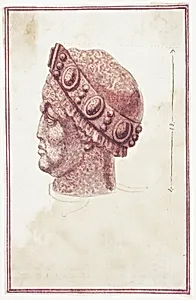
Medium
Gouache over black chalk, with pen and brown ink, on ivory laid paper
Dimensions
16.5 × 10.6 cm (6 1/2 × 4 3/16 in.)
Classification
gouache
Department
Prints and Drawings
Museum
Art Institute of Chicago
Accession Number
115496
Rights
Public Domain
Art Historical Context
Welcome to the Art Institute of Chicago's Prints Drawings collection, where Giuseppe Grisoni's *Porphyry Head (San Marco, Venice)*ivates with its delicate precision. Created in gouache over black chalk, accented by pen and brown on ivory laid paper, this undated study measures just 16.5 × 10.6 cm—small enough to hold in your hand. Grisoni, an 18th-century Italian artist known for his Baroque flair and work in England and Italy, meticulously renders one of Venice's iconic ancient treasures: a porphyry bust from St. Mark's Basilica. These vivid purple stone portraits, likely late Roman sculptures of the Tetrarchs, symbolize imperial power and have long fascinated artists and collectors. The mixed-media technique shines here—black chalk sketches the form, brown ink adds crisp outlines, and opaque gouache brings lifelike color and texture to the stone's polished sheen. Gouache's vibrancy on laid paper allowed Grisoni to capture the bust's stoic gaze and intricate details in an intimate format, ideal for study or private admiration. This work bridges antiquity and the Rococo era, highlighting how Renaissance and Baroque artists revered classical artifacts as sources of inspiration. Fun fact: Porphyry, prized in antiquity for its rarity, was quarried only in Egypt's Eastern Desert, making these heads enduring emblems of lost empires. Grisoni's drawing invites us to ponder their mysterious origins while marveling at his masterful touch. (198 words)
About the Artist
Giuseppe Grisoni · 1699–1769
Giuseppe Grisoni was born in Mons, in the Spanish Netherlands, in 1699, to an Italian family, and his career unfolded across multiple European courts and cultural centers, making him a quintessentially cosmopolitan figure of the early eighteenth century. He received his artistic training in Florence, where he absorbed the rich tradition of Florentine portraiture and absorbed the influence of the G...