
Porringer
1700–1725
Medium
Silver
Dimensions
Overall: 1 7/8 x 7 15/16 in. (4.8 x 20.2 cm); 9 oz. 3 dwt. (284.4 g) Lip: Diam. 5 5/16 in. (13.5 cm) Body: Diam. 5 1/2 in. (14 cm)
Classification
Porringer
Culture
American
Department
The American Wing
Museum
Metropolitan Museum of Art, New York, NY
Credit
Gift of Annie Clarkson, 1927
Accession Number
27.85.4
Rights
Public Domain
Art Historical Context
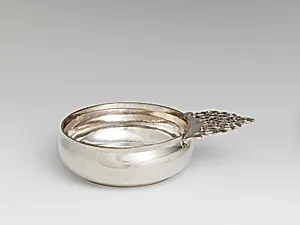
Crafted by the skilled New York silversmith Peter Van Dy between 1700 and 1725, this elegant porringer exemplifies early American silverwork from the colonial era. Porringers were versatile vessels—used for serving porridge, as drinking cups for children, or even for small portions of food—prized for their practicality and refined beauty in prosperous households. Van Dyck of Dutch descent and active in New York City's Huguenot silversmithing community, produced pieces blending European influences with emerging American tastes, making this a hallmark of Queen Anne-style domestic silver. The porringer's gleaming silver medium underscores its status as a luxury item; silver was laboriously sourced, refined, and hammered into shape, symbolizing wealth and craftsmanship in the early 18th century. Measuring just under 2 inches tall with a 5½-inch body diameter and weighing over 9 ounces, its compact form and flared lip highlight the silversmith's precision in balancing form and function. Subtle proportions reflect the era's shift toward graceful, restrained elegance amid colonial growth. Today, housed in The Metropolitan Museum of Art's American Wing and gifted by Annie Clarkson in 1927, this porringer offers a tangible glimpse into everyday life in colonial America, celebrating the artistry of immigrant makers who shaped the nation's decorative traditions.