
Portable equatorial sundial
ca. 1772–90
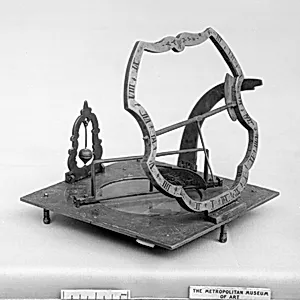
Medium
Brass
Dimensions
Overall: 3 1/2 × 3 1/4 × 3 1/8 in. (8.9 × 8.3 × 7.9 cm)
Classification
Horology
Culture
German, Augsburg
Department
European Sculpture and Decorative Arts
Museum
Metropolitan Museum of Art, New York, NY
Credit
Gift of Mrs. Stephen D. Tucker, 1903
Accession Number
03.21.19
Rights
Public Domain
Tags
Art Historical Context
Step into the ingenious world of 18th horology with Lorenz Gräsl's *Portable Equatorial Sundial*, crafted around 1772–90 in Augsburg, Germany—a hub of precision metalworking renowned for its skilled brass artisans. This compact brass instrument, measuring just 3½ × 3¼ × 3⅛ inches, exemplifies the Enlightenment-era fusion of science and artistry. Gräsl, a instrument maker, fashioned it to harness the sun's shadow for accurate timekeeping, adjustable for different latitudes via its design, making it a traveler's essential. Brass was the ideal medium: corrosion-resistant, highly polishable, and perfect for intricate engravings that ensured readability and durability. Housed in the Metropolitan Museum of Art's European Sculpture and Decorative Arts collection, this sundial reflects Augsburg's golden age of scientific instruments, blending mathematical precision with decorative elegance. Sundials like this bridged astronomy and everyday utility, offering a mechanical alternative to cumbersome clocks before widespread watchmaking. Fun fact: Pocket-sized and portable, it allowed 18th-century explorers or merchants to track time reliably under open skies, underscoring humanity's timeless quest to master the heavens. A testament to German craftsmanship, it invites us to ponder how such "decorative" arts advanced knowledge.