
Portable equatorial sundial
ca. 1721–26
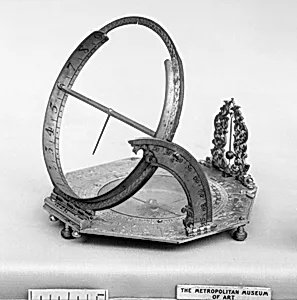
Medium
Copper, water-gilt, silver
Dimensions
Overall: 3 3/4 × 3 1/16 in. (9.5 × 7.8 cm)
Classification
Horology
Culture
German, Augsburg
Department
European Sculpture and Decorative Arts
Museum
Metropolitan Museum of Art, New York, NY
Credit
Gift of Mrs. Stephen D. Tucker, 1903
Accession Number
03.21.43
Rights
Public Domain
Tags
Art Historical Context
Crafted around 1721–26 by Johann Mathias Willebrand, a skilled instrument maker from Augsburg, Germany, this equatorial sundial exemplifies the era's fusion of scientific precision and exquisite craftsmanship. Measuring just 3¾ × 3⅛ inches, it was designed for travelers and scholars, allowing users to determine local time by aligning it with the sun and adjusting for latitude. Augsburg was a renowned hub for horology and metalworking in the early 18th century, producing luxurious instruments that blended functionality with decorative flair. Made of copper with water-gilding and silver accents, the sundial's gleaming surfaces highlight advanced gilding techniques—water-gilding created a smooth, mercury-free luster that enhanced durability and elegance. The intricate engravings and adjustable components reflect Baroque influences, where scientific tools doubled as status symbols for the educated elite. As part of the Metropolitan Museum of Art's European Sculpture and Decorative Arts collection, gifted in 1903, it offers a window into the Enlightenment's passion for astronomy and portable knowledge. This charming artifact reminds us how 18th-century ingenuity turned sunlight into timekeeping art, bridging utility and beauty in everyday discovery.