
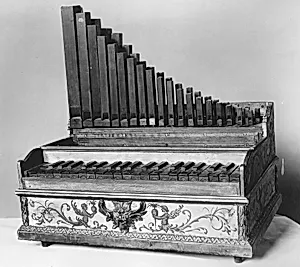
Portative Organ
late 19th century
Medium
Wood, various materials
Dimensions
Total h. 61.3 cm Width 59.7 cm Length perpendicular to keyboard 41.6 Three-octave span 51.8
Classification
Aerophone-Organ
Culture
Italian
Department
Musical Instruments
Museum
Metropolitan Museum of Art, New York, NY
Credit
The Crosby Brown Collection of Musical Instruments, 1889
Accession Number
89.4.1188
Rights
Public Domain
Art Historical Context
This charming Portative Organ, crafted by Italian maker Leopoldo Franciolini in the late nineteenth century, represents a revival of one of the most portable wind instruments of the medieval and Renaissance eras. Standing just over two feet tall, the compact instrument—made primarily of wood with various other materials—features a three-octave keyboard and was designed to be played while carried, typically suspended from the player’s shoulder. Its modest dimensions highlight the practical ingenuity of such organs, which allowed musicians to accompany singers or processions with a surprisingly full sound produced by hand-pumped bellows and metal pipes. Although created centuries after the original portative organs flourished in European courts and churches, Franciolini’s version captures the spirit of these historical aerophones. As part of the Metropolitan Museum’s Crosby Brown Collection of Musical Instruments, the piece offers visitors a tangible connection to centuries of musical tradition while reflecting nineteenth-century fascination with early music and craftsmanship. Its presence in the collection underscores the enduring appeal of instruments that blend utility, artistry, and portability.