
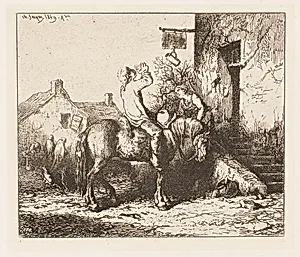
Porte d'Auberge
Medium
figures
Classification
figures
Department
Smithsonian Collection
Museum
Smithsonian American Art Museum
Credit
Gift of Jules R. Breuchaud
Accession Number
1962-32-71
Rights
Public Domain
About this artwork
Research in Progress
Art Historical Context
**Porte d'Auberge** (1849) by French artist Charles Émile Jacque (1813–1894) invites visitors into the rustic charm of 19th-century rural France. Jacque, a key figure in the Barbizon School was renowned for his vivid depictions of peasant life, farm animals, and pastoral landscapes. Created during a pivotal year when Jacque was deeply engaged in etching and painting everyday scenes, this work—classified among "figures"—likely captures the lively threshold of an inn door (*porte d'auberge*), a common motif symbolizing respite for travelers and workers in the French countryside. The artwork's medium of figures highlights Jacque's skill in rendering human forms with realistic detail and warmth, reflecting the Realist movement's shift away from idealized subjects toward authentic daily existence. Produced amid France's post-revolutionary social changes, it evokes the era's fascination with rural simplicity amid urban industrialization. Today, housed in the Smithsonian American Art Museum as a gift from Jules R. Breuchaud, *Porte d'Auberge* stands as a testament to Jacque's enduring influence on genre painting, bridging European traditions with American collections. Though research continues, this piece offers a window into mid-19th-century life, reminding us of art's power to preserve fleeting moments of human connection. (198 words)