
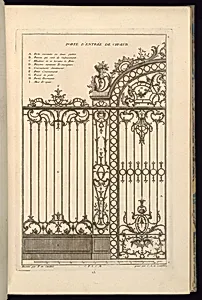
Porte d'Entrée de Choeur
Classification
metalwork
Department
Smithsonian Collection
Museum
Smithsonian American Art Museum
Credit
Purchased for the Museum by the Advisory Council
Accession Number
1921-6-285-43
Rights
Public Domain
About this artwork
Research in Progress
Art Historical Context
**Porte d'Entrée de Choeur** *François de Cuvilli the Elder (Belgian, active in, 1695–1768), 1745* *Metalwork, Smithsonian American Art Museum* into the opulent world of 18th-century European decorative arts with *Porte d'Entrée de Choeur* ("Entrance Door of the Choir"), a masterful metalwork piece by François de Cuvilliés Elder. Born in Belgium but renowned for his work at the Bavarian court, Cuvilliés was a figure in the Rococo movement, blending French elegance with German craftsmanship. Created in 1745, this choir entrance door likely adorned a grand ecclesiastical space, serving as a symbolic threshold between nave and sanctuary. As metalwork from the height of Rococo, the piece exemplifies the era's love for intricate ornamentation—think swirling motifs, gilded flourishes, and delicate asymmetry that evoke movement and light. Cuvilliés, who rose from humble origins as a dwarf actor to become the Elector Maximilian III Joseph's architect, infused his designs with theatrical flair, seen in masterpieces like the Amalienburg pavilion at Nymphenburg Palace. Though the exact medium details are under research, such works highlight metal's versatility for durable, shimmering liturgical art. Purchased for the Smithsonian American Art Museum by the Advisory Council, this artifact bridges European opulence and American collecting tastes, inviting us to appreciate how Rococo metalwork elevated sacred spaces into realms of wonder. A testament to Cuvilliés' enduring legacy, it whispers of devotion crafted with exquisite skill. (198 words)