
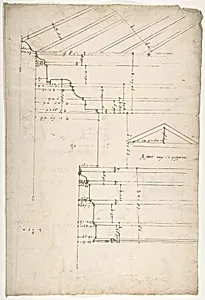
Portico Octavia, pediment and entablature, elevation; pediment, elevation (recto) Temple of Antoninus and Faustina, entablature, elevation (verso)
early to mid-16th century
Medium
Dark brown ink, black chalk, and incised lines
Dimensions
sheet: 17 1/8 x 11 3/4 in. (43.5 x 29.8 cm)
Classification
Drawings|Ornament & Architecture
Department
Drawings and Prints
Museum
Metropolitan Museum of Art, New York, NY
Credit
Purchase, Rogers Fund, Joseph Pulitzer Bequest, and Mark J. Millard Gift, 1968
Accession Number
68.769.50
Rights
Public Domain
Tags
Art Historical Context
This exquisite double-sided drawing from early to mid-16th France captures the grandeur of ancient Roman architecture through precise elevations. On the recto, an anonymous artist meticulously renders the pediment and entature of the Porticoavia—a sprawling portico in Rome built in the 2nd century BCE and later rebuilt under Augustus—alongside a detailed pediment study. The verso features the entablature of Temple of Antoninus andina, erected in 141 CE in the Roman Forum and today serving as the Church of San Lorenzo in Miranda Created with dark brown ink, black chalk, and incised lines on a sheet measuring 17 1/8 x 11 3/4 inches, it exemplifies Renaissance draftsman's skill in documenting classical ornament. During the 16th century, French artists and architects traveled to Rome to study antiquity, fueling the Renaissance revival of classical forms. These drawings likely served as pattern books or study aids, with incised lines allowing tracings for replication—a practical technique for disseminating Roman motifs across Europe. Housed in the Metropolitan Museum of Art's Drawings and Prints department (acquired in 1968 via the Rogers Fund, Joseph Pulitzer Bequest, and Mark J. Millard Gift), it highlights the era's obsession with harmonious proportions and decorative details like triglyphs and metopes. Such works bridged ancient Rome and modern design, influencing French Renaissance architecture from châteaux to urban facades. Visitors, marvel at how a simple sheet preserves the eternal elegance of imperial splendor!