
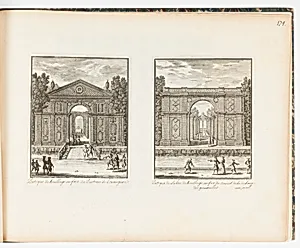
Portique de treillage en face du Parterre de l’orangerie
Classification
Department
Smithsonian Collection
Museum
Smithsonian American Art Museum
Credit
Purchased for the Museum by the Advisory Council
Accession Number
1921-6-334-6
Rights
Public Domain
About this artwork
Research in Progress
Art Historical Context
Adam Perelle (1638–1695), a prominent French engraver, captures the elegance of 17th-century French garden architecture in *Portique de treillage face du Parterre de l’orangerie* (Trellis Portico Facing the Orang Parterre), created between 1670 and1695. As a master of detailed prints, Perelle specialized in topographic views that celebrated the grandeur of royal estates, particularly the meticulously designed gardens of Versailles under Louis XIV. This work likely depicts a latticed portico—a decorative trellis structure—overlooking the formal parterre beds near an orangery, where citrus trees were housed in opulent greenhouses during France's Golden Age. Prints like this one were revolutionary for their time, serving as both artistic reproductions and promotional tools. They allowed the splendor of Versailles' landscapes—symbols of absolutist power and horticultural innovation—to reach a wider European audience, influencing garden design across the continent. Perelle's precise line work and perspective techniques highlighted the symmetry and scale of these spaces, blending architecture with nature in the Baroque style. Housed in the Smithsonian American Art Museum, this piece invites visitors to envision the sensory delights of a bygone era: the scent of orange blossoms, the rustle of clipped hedges, and the Sun King's vision of paradise made manifest. Research continues to uncover more about its creation, underscoring its enduring allure.