
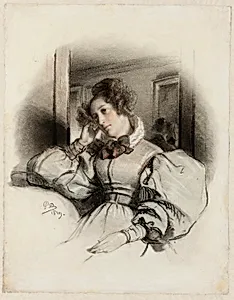
Portrait de Mme. E. D.
1829
Medium
Black, white, and red chalks, with stumping and erasing on ivory wove paper, perimeter mounted to Japanese paper
Dimensions
24 × 18.8 cm (9 1/2 × 7 7/16 in.)
Classification
prints and drawing
Department
Prints and Drawings
Museum
Art Institute of Chicago
Accession Number
191212
Rights
Public Domain
About this artwork
Delaroche sought to infuse his works with great emotional and moral expressiveness. Rendered with the soft-focus, “porthole” perspective of contemporary daguerreotype photography, this unidentified female portrait blends the romantic pose of a melancholy woman with the delicacy of an Ingres odalisque. It is unclear how the amorous couple at the door in the background relates to the contemplative woman.
Art Historical Context
Created in 1829 by French artist Paul Delaroche, *Portrait de Mme. E. D.* offers an intimate glimpse into early nineteenth-century portraiture. Rendered in black, white, and red chalks on ivory wove paper, the drawing captures its subject with remarkable delicacy and warmth. The small scale—measuring just 24 by 18.8 centimeters—invites close viewing, suggesting the work may have been intended for private appreciation rather than public display. Delaroche employed the classic *trois crayons* technique, combining three colored chalks with stumping and erasing to achieve soft transitions of light and shadow. This approach allows the portrait to convey both the texture of skin and the subtle play of light across fabric and features, demonstrating the artist’s skill in creating lifelike volume within a limited palette. The sheet’s careful mounting onto Japanese paper further highlights the value placed on preserving such sensitive works. Now housed in the Prints and Drawings department of the Art Institute of Chicago, this drawing exemplifies the refined draftsmanship prized during the Romantic era. Its restrained yet expressive handling of chalk reveals how artists of the period used modest materials to explore personality and presence with enduring sensitivity.