
Portrait de vielles femmes
1895
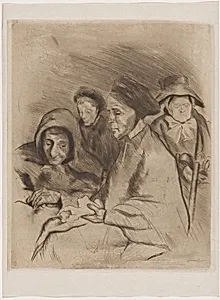
Medium
drypoint in brown on japan paper
Classification
Department
CG-E
Museum
National Gallery of Art, Washington, D.C.
Credit
Virginia and Ira Jackson Collection, gift in memory of Virginia H. Jackson
Accession Number
1996.151.183
Rights
Public Domain
Art Historical Context
Georges Jeanniot's *Portrait de vieilles femmes (Portrait of Old Women), created in 1895, the quiet dignity of its subjects through the intimate medium of drypoint A French artist and close associate of Edgar Degas, Jeanniot was renowned for his sensitive portrayals of everyday life, blending realist observation with a touch of impressionistic warmth. This print, housed in the National Gallery of's Virginia and Ira Jackson Collection, reflects the fin-de-siècle fascination with human character and aging, rendered in soft brown ink on delicate Japan paper—a luxurious, thin sheet prized by printmakers for its ability to hold fine details and subtle tones. Drypoint, Jeanniot's chosen technique, involves scratching directly into a metal plate, raising a soft burr that produces velvety, expressive lines unlike the crisp edges of etching. The brown ink adds a warm, earthy depth, evoking the textured skin and folds of the women's faces and garments. This method allowed Jeanniot to achieve a painterly immediacy in print form, bridging painting and graphics during a time when French printmaking flourished alongside movements like Symbolism and Art Nouveau. Displayed in the museum's prints department, this work invites visitors to appreciate the artistry of ephemera—intimate studies that preserve fleeting moments. A gift in memory of Virginia H. Jackson, it underscores the enduring value of such personal, humanistic prints in art history.