
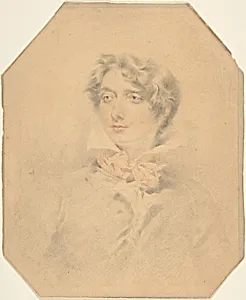
Portrait Head
Medium
Graphite and red chalk
Dimensions
Overall: 9 3/16 x 7 5/16 in. (23.4 x 18.6 cm) (octagonal)
Classification
Drawings
Department
Drawings and Prints
Museum
Metropolitan Museum of Art, New York, NY
Credit
Rogers Fund, 1946
Accession Number
46.52
Rights
Public Domain
Tags
Art Historical Context
George Henry Harlow's *Portrait Head* (1816) is a delicate preparatory drawing capturing the poised features of an unidentified woman. Created during the Regency era in Britain, when portraiture flourished amid social upheaval and artistic innovation, this octagonal sheet exemplifies Harlow's skill as a rising portraitist influenced by masters like Sir Thomas Lawrence. Harlow, who tragically died young at 21, was celebrated for his fluid, expressive style that bridged Neoclassicism and emerging Romanticism, often rendering sitters with lifelike immediacy. Rendered in graphite for precise contours and shading, paired with red chalk for warm, fleshy tones on the cheeks and lips, the medium highlights Harlow's mastery of mixed techniques. These materials were staples in artists' studios for studies destined for larger oil paintings or engravings, allowing rapid yet nuanced exploration of form and expression. The intimate scale—about 9 by 7 inches—invites close viewing, emphasizing the subject's direct gaze and soft modeling. Acquired by The Metropolitan Museum of Art in 1946 through the Rogers Fund, this drawing offers a glimpse into early 19th-century British draftsmanship. Its tags—heads, portraits, women—underscore its focus on feminine elegance, a popular Regency motif reflecting societal ideals of beauty and poise. A charming survivor from Harlow's brief career, it reminds us how sketches like this fueled the era's vibrant portrait tradition.