
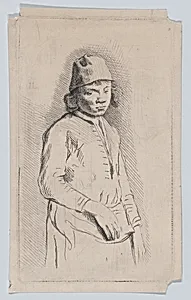
Portrait of a boy
Medium
Etching
Dimensions
Plate: 7 3/8 × 4 5/16 in. (18.7 × 11 cm) Sheet: 7 15/16 × 4 3/4 in. (20.1 × 12 cm)
Classification
Prints
Department
Drawings and Prints
Museum
Metropolitan Museum of Art, New York, NY
Credit
The Elisha Whittelsey Collection, The Elisha Whittelsey Fund, 1951
Accession Number
59.592.14
Rights
Public Domain
Tags
Art Historical Context
This delicate etching, titled *Portrait of a Boy* and sometimes attributed to the Dutch Baroque master Jan Lievens (1607–1674), the innocence and direct gaze of its young subject. Lievens, a contemporary and friend of Rembrandt, was renowned for his expressive portraits and innovative printmaking during the Dutch Golden Age. Though the exact date remains unknown, the work exemplifies the intimate scale of 17th-century Dutch portraiture, rendered on a modest plate measuring just 7 3/8 × 4 5/16 inches. Etching, the medium here, involved coating a metal plate with acid-resistant ground, incising lines with a needle, and immersing it in acid to etch the grooves—allowing for rich tonal contrasts and subtle textures. This technique was pivotal in the era, enabling artists like Lievens to produce multiple impressions for wider dissemination, blending painting's detail with print's accessibility. The boy's attentive expression and finely hatched features highlight the psychological depth typical of Baroque portraits, inviting viewers to ponder his story. Housed in the Metropolitan Museum of Art's Drawings and Prints department as part of The Elisha Whittelsey Collection (acquired 1951), this anonymous-attributed gem offers a window into everyday childhood during a transformative period in European art, where portraiture elevated ordinary subjects to timeless elegance.
About the Artist
Anonymous|Jan Lievens
In the vast tapestry of art history, "Anonymous" stands not as a singular individual but as a collective designation for countless unidentified creators whose works have endured across millennia. These artists, spanning prehistoric cave painters to medieval illuminators and folk craftsmen, produced the foundational layers of human visual culture. Prior to the Renaissance, when individual fame emer...