
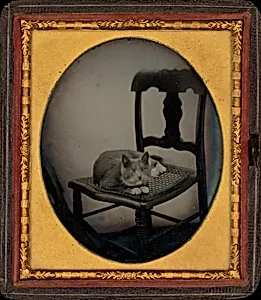
Portrait of a Cat
c. 1858
Medium
ambrotype
Dimensions
image (visible): 7.1 × 5.9 cm (2 13/16 × 2 5/16 in.) mat: 8.2 × 6.7 cm (3 1/4 × 2 5/8 in.) case (closed): 9.5 × 9 × 2.1 cm (3 3/4 × 3 9/16 × 13/16 in.)
Classification
Photograph
Department
CPH
Museum
National Gallery of Art, Washington, D.C.
Credit
Ross J. Kelbaugh Collection, Purchased with support from the Ford Foundation
Accession Number
2023.39.11
Rights
Public Domain
Art Historical Context
Behold the charming *Portrait of a Cat* by Glenalvin Goodridge created around 1858. This intimate ambrotype captures a feline subject with remarkable clarity, housed in a compact case measuring just 9.5 × 9 × 2.1 cm when closed—perfect for carrying as a personal treasure, much like a locket. Now part of the National Gallery of Art'sPH department, it entered the collection through the Ross J. Kelbaugh Collection, supported by the Ford Foundation. Ambrotypes, popular in the 1850s, were a breakthrough in photography: a unique positive image made on glass using the wet collodion process, backed with black velvet or paint to create the illusion of a richly toned print. Unlike fragile daguerreotypes, ambrotypes were more affordable and durable, democratizing portraiture during a time when photography was transitioning from novelty to everyday memento. What makes this piece especially delightful is its unconventional subject—a cat, rendered with lifelike detail in a era dominated by human portraits. Goodridge's skill highlights the era's growing affection for pets as family members, offering a whimsical glimpse into 19th-century domestic life through this tiny, treasured window.