
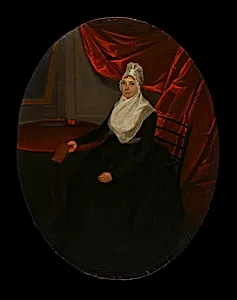
Portrait of a Connecticut Clockmaker's Wife
ca. 1800
Medium
Painting
Classification
Painting
Department
Smithsonian Collection
Museum
Smithsonian American Art Museum
Credit
Smithsonian American Art Museum, Gift of Orrin Wickersham June
Accession Number
1967.136.3
Tags
About this artwork
This painting of a Connecticut clockmakerâs wife was meant to hang to the right of her husbandâs portrait, preserving their images and values for subsequent generations. Ralph Earl showed her holding a book, possibly a Bible, as a sign of piety and literacy. The drapery in the background was a compositional device that the artist learned when he studied portraiture in England.
Art Historical Context
In the early years of the 19th century, Ralph Earl captured the poised likeness of a Connecticut clockmaker's wife in intimate portrait, painted around 1800. As a itinerant artist in New England, Earl specialized in folk-style portraits that celebrated everyday American families, blending simplicity with subtle elegance. This work was designed to hang to the right of her husband's, a common practice among the emerging middle class to immortalize their images, values, and social standing for future generations. The subject holds a book—likely a Bible—symbolizing her piety and literacy, virtues...
About the Artist
Ralph Earl · 1751–1801
Ralph Earl (1751–1801) was born on May 11 in Shrewsbury or Leicester, Massachusetts, the eldest of four children to Ralph Earle, a colonel in the Revolutionary army, and Phebe Whittemore Earl. Growing up amid farmers and craftsmen in Worcester County, Earl displayed prodigious talent as a self-taught artist, emulating the works of John Singleton Copley after observing his half-brother Henry Pelham...