
Portrait of a Gentleman
1770/1825
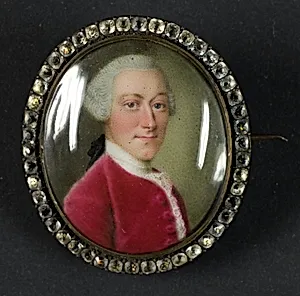
Medium
Enamel
Dimensions
2.9 × 2.5 cm (1 1/8 × 1 in.); Framed: 3.8 × 3.5 cm (1 1/2 × 1 3/8 in.)
Classification
miniature painting
Department
Painting and Sculpture of Europe
Museum
Art Institute of Chicago
Accession Number
20853
Rights
Public Domain
Art Historical Context
Step into the intimate world of 18th- and early 19th-century miniature portraiture with *Portrait of a Gentleman* by Horace Hone, an Irish artist renowned for his delicate enamel works. Created sometime between 1770 and1825, this tiny measures just 2.9 × 2.5 cm (1 1/8 × 1 in.), small enough to fit into a locket or brooch—perfect for wearing close to the heart. Hone's mastery shines in the enamel medium, a technically demanding process where pigments are fused onto a metal base through multiple kiln firings, yielding a luminous, gem-like durability unmatched by fragile watercolors on ivory. Popular among Europe's aristocracy during the Georgian era, these miniatures captured the essence of sitters with remarkable precision, serving as cherished mementos, tokens of affection, or symbols of status amid the Enlightenment's emphasis on individualism. Housed in the Art Institute of Chicago's Department of Painting and Sculpture of Europe, this work exemplifies the refined artistry of miniature painting, a specialized craft that blended portraiture's psychological depth with jewelry's portability. Imagine a gentleman’s poised gaze preserved for generations— a testament to Hone's enduring legacy in capturing fleeting humanity on an eternal scale.
About the Artist
Horace Hone · 1749–1825
Horace Hone (1754–1825) was an English painter renowned for his miniature portraits. Born on 11 February 1754 in Frith Street, London, he was the eldest son of the prominent miniaturist Nathaniel Hone and Mary Hone (née Earle). His father provided his initial artistic training, and Hone later entered the Royal Academy Schools in 1770. He first exhibited at the Royal Academy in 1772 and was elected...