
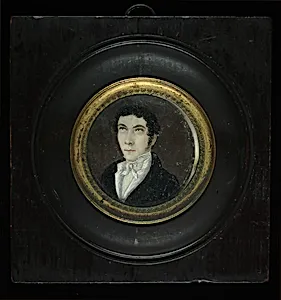
Portrait of a Gentleman
ca. 1810
Medium
Painting-Miniature
Classification
Painting-Miniature
Department
Smithsonian Collection
Museum
Smithsonian American Art Museum
Credit
Smithsonian American Art Museum, Teodoro Vidal Collection
Accession Number
1996.91.27
Rights
Public Domain
Tags
About this artwork
The unidentified gentleman’s neatly tied cravat contrasts with his disheveled hairstyle, both of which were common to early-nineteenth-century fashions. In this framed miniature the sitter’s upward glance, possibly to heaven, suggests it was commissioned to mourn the recent loss of a loved one.
Art Historical Context
This exquisite *Portrait of a Gentleman*, created around 1810 by an unidentified Puerto Rican artist, captures the intimate essence of early 19th-century portrait in a delicate miniature painting. Miniatures like this were prized personal treasures, often framed or worn as jewelry, allowing loved ones to keep a likeness close. Housed in the Smithsonian American Art Museum's Te Vidal Collection, it exemplifies the refined craftsmanship of Puerto Rican artists during Spanish colonial rule, when such works served as cherished mementos amid a vibrant Creole culture blending European and local influences. The bust-length portrait reveals a gentleman with a neatly tied cravat—symbolizing formality—offset by his tousled, disheveled hairstyle, both hallmarks of Regency-era fashions popular in the Atlantic world. His upward glance, perhaps toward heaven, lends a poignant, memorial quality, suggesting the piece was commissioned to honor a recently deceased loved one. This emotional depth, rendered in fine detail on a tiny scale, highlights the artist's mastery of subtle expression and texture. As a rare surviving example of Puerto Rican miniature painting, it offers a window into colonial elite life and the era's blend of mourning rituals with portrait traditions, inviting us to ponder the gentleman's untold story.