
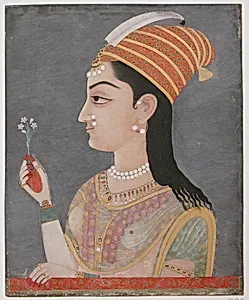
Portrait of a Lady
Unknown Artist
late 17th–18th century
Medium
Opaque watercolor and gold on paper
Dimensions
H. 10 1/4 in. (26 cm) W. 8 1/4 in. (21 cm)
Classification
Codices
Department
Islamic Art
Museum
Metropolitan Museum of Art, New York, NY
Credit
Bequest of Cora Timken Burnett, 1956
Accession Number
57.51.11
Rights
Public Domain
Tags
Art Historical Context
This delicate *Portrait of a Lady*, created by an unknown artist in the 17th to 18th century, exemplifies refined miniature painting tradition of Islamic art. Rendered in opaque watercolor and gold on paper the intimate 10¼ × 8¼-inch (26 × 21 cm) work captures a woman's profile with graceful poise, her elegant features framed by flowing attire and intricate jewelry. Housed in the Metropolitan Museum of Art's Islamic Art Department and classified as a codex leaf—likely from an album or manuscript—this piece reflects the portability and precision prized in Persianate and Mughal courts. Profile portraits like this were a hallmark of Islamic miniature painting, emphasizing idealized beauty, status, and introspection over full-face realism, influenced by earlier Persian traditions. The lavish use of gold highlights adds a luminous, jewel-like quality, evoking the opulence of royal patronage during the Safavid, Mughal, or Ottoman eras. Such works often served as personal treasures, exchanged among elites to convey refinement and cultural identity. Bequeathed to the Met in 1956 by Cora Timken Burnett, this artwork invites visitors to appreciate the artistry of anonymity—where technique and cultural resonance speak volumes. It offers a window into the lives of women in Islamic societies, their poised silhouettes enduring as symbols of timeless elegance.