
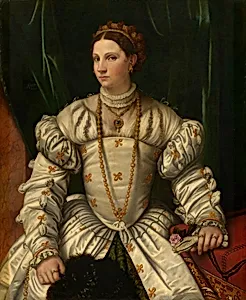
Portrait of a Lady in White
c. 1540
Medium
oil on canvas
Dimensions
overall: 106.4 × 87.6 cm (41 7/8 × 34 1/2 in.) framed: 142.24 × 116.21 × 10.8 cm (56 × 45 3/4 × 4 1/4 in.)
Classification
Painting
Department
CIS-R
Museum
National Gallery of Art, Washington, D.C.
Credit
Samuel H. Kress Collection
Accession Number
1939.1.230
Rights
Public Domain
Art Historical Context
Painted around 1540 by Moretto da Brescia, an important Lombard artist of the Italian Renaissance, *Portrait of a Lady in White* exemplifies the refined portraiture that flourished in northern Italy during this period. Moretto, whose real name was Alessandro Bonvicino, worked primarily in Brescia and combined the luminous color and atmospheric effects of Venetian painting with a more restrained, introspective Lombard sensibility. His portraits often convey both the social standing and inner composure of their subjects. The sitter’s elegant white gown, rendered with meticulous attention to fabric texture and soft folds, signals wealth and refinement while also evoking ideals of purity and virtue prized in Renaissance society. Executed in oil on canvas—a medium that allowed artists to achieve subtle gradations of light and rich tonal harmonies—the painting demonstrates Moretto’s skill at modeling form and capturing the quiet presence of his sitters. Now in the National Gallery of Art’s Samuel H. Kress Collection, the work remains a compelling example of how sixteenth-century Italian artists balanced individual likeness with idealized elegance.
About the Artist
Moretto da Brescia · 1498–1554
**Moretto da Brescia (Alessandro Bonvicino, c. 1498–1554)** was a leading Italian Renaissance painter based in Brescia, where he produced most of his work. Born in nearby Rovato, he trained initially under the local master Fioravante (or Floriano) Ferramola and absorbed influences from earlier Brescian artists such as Vincenzo Foppa. His style also reflects strong Venetian elements, particularly f...