
Portrait of a Man
c. 1845
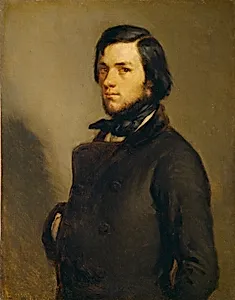
Medium
oil on canvas
Dimensions
overall: 40.6 x 32.3 cm (16 x 12 11/16 in.) framed: 55.9 x 47.3 x 4.9 cm (22 x 18 5/8 x 1 15/16 in.)
Classification
Painting
Department
CF
Museum
National Gallery of Art, Washington, D.C.
Credit
Chester Dale Collection
Accession Number
1963.10.43
Rights
Public Domain
Art Historical Context
Jean-François Millet’s *Portrait of a Man*, painted around 1845, offers a glimpse into the early career of an artist would later become one of most celebrated figures of the Realist movement. At this stage, Millet was still establishing himself in Paris after training in his native Normandy. The modest scale of the oil-on-canvas work—roughly 16 by 13 inches—creates an intimate encounter, inviting viewers to study the sitter’s features and expression up close. Oil paint, the medium Millet employed here, allowed artists of the period to achieve rich tonal depth and subtle transitions of light and shadow. This technical flexibility suited the emerging interest in truthful, unidealized depictions of individuals, a direction Millet would fully embrace in his later rural scenes. Created just before the 1848 Revolution, the portrait reflects a moment when French artists were beginning to turn toward everyday subjects with greater honesty and emotional directness. Acquired by the National Gallery of Art through the Chester Dale Collection, the painting stands as a quiet testament to Millet’s developing skill and the broader shift toward Realism that would define mid-nineteenth-century French art.
About the Artist
Jean-François Millet · 1814–1875
Jean-François Millet (1814-1875) was a French painter and one of the founders of the Barbizon school, whose dignified depictions of peasant laborers transformed how art could represent rural life. His monumental images of sowers, gleaners, and field workers elevated common people to subjects previously reserved for mythological or historical figures, making him a pivotal figure in the development ...