
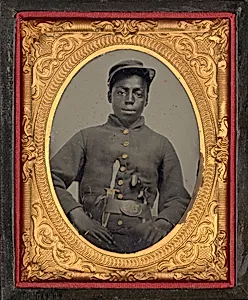
Portrait of a Soldier
c. 1863
Medium
ambrotype with applied color
Dimensions
image (visible): 5 × 3.7 cm (1 15/16 × 1 7/16 in.) mat: 6.4 × 5 cm (2 1/2 × 1 15/16 in.) case (closed): 7.4 × 6.3 × 1.7 cm (2 15/16 × 2 1/2 × 11/16 in.)
Classification
Photograph
Department
CPH
Museum
National Gallery of Art, Washington, D.C.
Credit
Ross J. Kelbaugh Collection, Purchased with support from the Ford Foundation
Accession Number
2023.39.60
Rights
Public Domain
Art Historical Context
**Portrait of a Soldier**c. 1863 *American 19th Century* Ambrotype with applied colorNational Gallery of Art, J. Kelbaugh Captured around 1863 amid the American Civil War, poignant *Portrait of a Soldier* exemplifies the era's booming popularity of photography as a personal memento. Ambrotypes, produced via the wet-collodion process glass plates, were affordable accessible alternatives to daguerreotypes, allowing everyday soldiers to send images home to loved ones. This tiny portrait—measuring just under 2 inches tall—likely served as a cherished token of remembrance, evoking the human face of conflict for families on both sides of the Mason-Dixon line. The medium's innovation shines through its applied color, hand-tinted with fine brushes to add lifelike flesh tones, rosy cheeks, and uniform details, transforming a monochromatic negative into a vivid, positive image when backed with black material. Such enhancements made these portraits emotionally resonant, bridging the distance between battlefield and hearth. Housed in a protective case, it reflects 19th-century photography's shift toward intimate, narrative storytelling, preserving anonymous heroes in the National Gallery's collection. (198 words)
About the Artist
American 19th Century · 1800–1900
The artist cataloged as "American, 19th Century" represents a collective of unidentified painters active in the United States during the nineteenth century, with 380 known artworks preserved in this virtual museum's collection. These works span a diverse array of genres typical of the era, including portraits, landscapes, still lifes, and genre scenes, reflecting the burgeoning artistic output of ...