
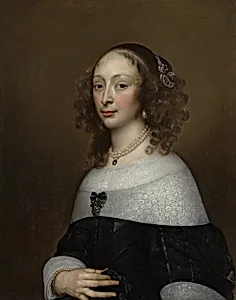
Portrait of a Woman
ca. 1653
Medium
Oil on canvas
Dimensions
31 1/2 x 25 in. (80 x 63.5 cm)
Classification
Paintings
Department
European Paintings
Museum
Metropolitan Museum of Art, New York, NY
Credit
Marquand Collection, Gift of Henry G. Marquand, 1889
Accession Number
89.15.27
Rights
Public Domain
Tags
About this artwork
Adriaen Hanneman, a Dutch portraitist who spent significant time in England and was influenced by Anthony van Dyck's elegant style, created this accomplished portrait around 1653. Hanneman specialized in portraying members of the Dutch and English aristocracy during the mid-seventeenth century, a period of political upheaval that included the English Civil War and the Dutch Golden Age's height. This portrait depicts an unidentified woman dressed in the fashionable attire of the 1650s, her costum...
Art Historical Context
Adriaen Hanneman, a Dutch portraitist active during the mid-seventeenth century, created this elegant work around 1653 while drawing heavily on the refined manner of Anthony van Dyck. Having spent formative years in England, Hanneman absorbed Van Dyck’s graceful poses and luminous handling of fabric, blending them with the Dutch sensitivity to texture and detail that characterized the Golden Age. The result is a portrait that speaks to the cosmopolitan exchanges between courts and cities at a time of political upheaval, including the English Civil War and the height of Dutch prosperity. The unidentified sitter appears in fashionable 1650s attire, her silk gown and delicate lace suggesting membership in the affluent merchant or minor noble circles that commissioned such images as markers of status. Painted on a relatively large scale in oil on canvas, the work uses a dark background to draw attention to the woman’s face and costume, while subtle modeling gives her a convincing three-dimensional presence. Hanneman’s careful attention to the sheen of fabric and the intricacy of lace reveals both technical skill and the sitter’s social standing. Acquired by the Metropolitan Museum in 1889 as part of Henry G. Marquand’s generous gift, the painting remains a fine example of how seventeenth-century European portraiture crossed national boundaries, serving as both personal keepsake and testament to an era of artistic mobility.