
Portrait of Alois Senefelder
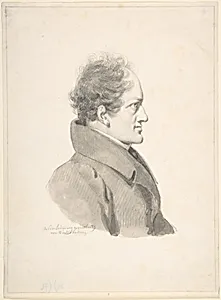
Medium
Graphite and brush and gray wash; framing lines in graphite
Dimensions
sheet: 9 1/16 x 6 5/8 in. (23 x 16.9 cm)
Classification
Drawings
Department
Drawings and Prints
Museum
Metropolitan Museum of Art, New York, NY
Credit
Harry G. Sperling Fund, 2008
Accession Number
2008.357
Rights
Public Domain
Tags
Art Historical Context
This delicate profile portrait of Aloisefelder, rendered in graphite with brush and gray wash, the inventor in a classical three-quarter view, framed by subtle graphite lines. Created around the era spanning 1805–73 and attributed in connection to Franz Xaver Winterhalter—a master of elegant portraiture known for his work with European royalty—the drawing measures a modest 9 1/16 x 6 5/8 inches. Housed in the Metropolitan Museum of Art's Drawings and Prints department (acquired via the Harry G. Sperling Fund in 2008), it exemplifies the precision of preparatory sketches from the Romantic period. Alois Senefelder (1771–1834) revolutionized printing by inventing lithography in the late 1790s, a technique using greasy crayons on stone that democratized image reproduction and paved the way for modern mass media. This intimate profile likely commemorates his legacy, highlighting his thoughtful visage amid the era's fascination with innovators. The gray wash adds soft tonal depth, mimicking the luminosity of oil portraits while showcasing graphite's versatility for fine details in preparatory works. As a study in profile, it evokes ancient Roman coins and Renaissance medallions, blending historical reverence with technical innovation—perfect for appreciating how drawings bridged invention and artistry in 19th-century Europe.
About the Artist
Alois Senefelder|Franz Xaver Winterhalter (German|German) · 1771 |1805 –1834 |1873
German, Prague 1771–1834 Munich|German, Menzenschwand 1805–1873 Frankfurt