
Portrait of Fernand
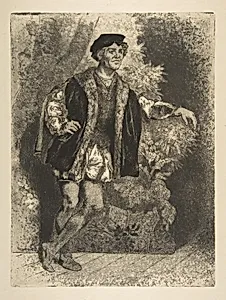
Medium
Etching, aquatint; third state of three
Dimensions
Sheet: 19 1/8 × 13 3/16 in. (48.5 × 33.5 cm) Plate: 13 1/2 × 10 1/16 in. (34.3 × 25.5 cm)
Classification
Prints
Department
Drawings and Prints
Museum
Metropolitan Museum of Art, New York, NY
Credit
Gift of David Keppel, 1922
Accession Number
22.1.4
Rights
Public Domain
Tags
Art Historical Context
Félix Bracquemond's *Portrait of Fernand*1876) is a masterful etching and aquatint, capturing the introspective gaze of its young subject—likely the artist's son—in intimate detail. Created during the height of France's etching revival in the late 19th century, third and final state of three showcases Bracquemond's prowess. As a leading printmaker influenced by Japanese woodcuts and Realism, he bridged traditional techniques with emerging modernist sensibilities, making prints accessible yet sophisticated art forms. The medium's significance lies in its layered processes: etching for precise lines and aquatint for subtle tonal gradations, evoking soft shadows and textures on the subject's face and clothing. Measuring 19 1/8 × 13 3/16 inches on the sheet, this work exemplifies how prints allowed artists like Bracquemond to experiment with multiple editions, refining compositions across states. Housed in the Metropolitan Museum of Art's Drawings and Prints department (gift of David Keppel, 1922), it highlights the era's fascination with portraiture as a window into personal identity amid rapid social change. Visitors will appreciate this piece for its tender humanity—a father's loving depiction amid artistic innovation—inviting reflection on family bonds in an age of industrial transformation.
About the Artist
Félix Bracquemond · 1833–1914
French, Paris 1833–1914 Sèvres