
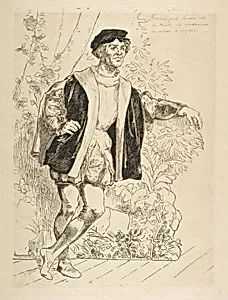
Portrait of Fernand
Medium
Etching; first state of three
Dimensions
Sheet: 18 5/8 × 13 1/4 in. (47.3 × 33.6 cm) Plate: 13 9/16 × 10 1/16 in. (34.5 × 25.6 cm)
Classification
Prints
Department
Drawings and Prints
Museum
Metropolitan Museum of Art, New York, NY
Credit
Gift of David Keppel, 1922
Accession Number
22.1.3
Rights
Public Domain
Tags
Art Historical Context
Félix Bracquemond’s *Portrait of Fernand* (1876) offers a striking example of the nineteenth-century etching revival in France. Working in the first state of three, Bracquemond captures his subject with delicate, exploratory lines that reveal the early stages of the plate. The inclusion of flowers and leaves surrounding the figure adds a naturalistic, almost decorative touch, softening the formality of the portrait while highlighting the artist’s interest in integrating human presence with organic motifs. As a print rather than a unique painting, this work underscores etching’s growing status as a respected artistic medium during the period. Bracquemond, a skilled printmaker, used the technique to achieve subtle tonal variations and textures that bring depth to the sitter’s features and the surrounding foliage. Housed in the Metropolitan Museum of Art’s collection of drawings and prints, the piece invites viewers to appreciate the intimacy and craftsmanship of early impressions, where every mark still feels fresh and provisional.
About the Artist
Félix Bracquemond · 1833–1914
French, Paris 1833–1914 Sèvres