
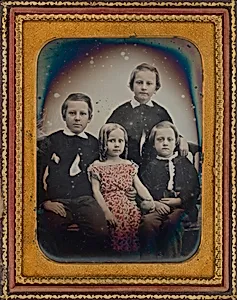
Portrait of Four Children
c. 1860
Medium
daguerreotype with applied color
Dimensions
image (visible): 9 × 6.5 cm (3 9/16 × 2 9/16 in.) mat: 10.6 × 7.9 cm (4 3/16 × 3 1/8 in.) case (closed): 11.9 × 9.5 × 2 cm (4 11/16 × 3 3/4 × 13/16 in.)
Classification
Photograph
Department
CPH
Museum
National Gallery of Art, Washington, D.C.
Credit
The Ross J. Kelbaugh Collection
Accession Number
2023.146.7
Rights
Public Domain
Art Historical Context
Step into the intimate world of mid-19th-century photography *Portrait of Four Children* Henry Pollock, created around 1860. This diminutive daguerreotype, measuring just 9 × 6.5 cm, captures solemn gazes of four young siblings, their formal attire and composed poses evoking the cherished family portraits of the Victorian era. Housed in a protective case typical of the time, it served as a treasured keepsake, much like a locket worn close to the heart. Daguerreotypy, invented in 1839, produced exquisitely detailed, one-of-a-kind images on polished silvered copper plates—mirrors of reality that mesmerized early viewers. Pollock enhanced this portrait with applied color, a hand-tinting technique using fine brushes and pigments to add lifelike cheeks, lips, and clothing hues. By 1860, as cheaper processes like ambrotypes emerged, such labor-intensive daguerreotypes represented the pinnacle of photographic artistry, blending science and craft. Now part of the National Gallery of Art's Ross J. Kelbaugh Collection, this work highlights photography's role in preserving fleeting childhood innocence amid a turbulent pre-Civil War America. It invites us to ponder the universal parental desire to freeze time, offering a poignant glimpse into everyday lives through an enduring technological marvel.