
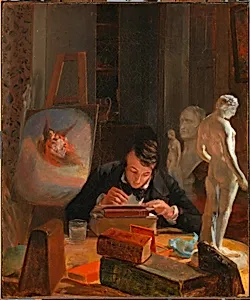
Portrait of Godfrey Frankenstein
ca. 1840
Medium
Painting
Classification
Painting
Department
Smithsonian Collection
Museum
Smithsonian American Art Museum
Credit
Smithsonian American Art Museum, Museum purchase
Accession Number
1973.159
Rights
Public Domain
Tags
About this artwork
John Frankenstein painted this portrait of his younger brother Godfrey, while they shared studio space in Ohio. Godfrey Frankenstein was elected president of the Cincinnati Academy of Fine Arts in 1841, and was later known as "The Painter of Niagara Falls" after creating about a hundred paintings of the national treasure. Here, John portrayed his brother surrounded by plaster casts of classical sculpture and numerous thick books, the largest of which is labeled "Schiller," probably referring to ...
Art Historical Context
In the early 1840s, American artist John Frankenstein captured a tender moment of fraternal camaraderie in *Portrait of Godfrey Frankenstein*, while the brothers shared a in Ohio. This intimate oil painting depicts John's younger Godfrey, dressed in a coat and tie, deeply engrossed in his own watercolor work. Surrounding him are symbols of artistic devotion: plaster casts of classical, stacks of thick books—including one boldly labeled "Schiller" after the renowned German poet and philosopher Friedrich Schiller—and a partially completed canvas behind him, possibly John's own unlocated works *Angel and Child* or *The Dawn of Life*. The scene evokes the intellectual and creative fervor of mid-19th-century American art circles, just as Godfrey rose to prominence. Elected president of the Cincinnati Academy of Fine Arts in 1841, he earned the nickname "The Painter of Niagara Falls" for his prolific depictions—nearly 100—of this natural wonder, blending Romantic awe with emerging national pride. Yet this tranquil portrayal contrasts sharply with John's later disillusionment; after years of obscurity and failed patronage, he penned the scathing poem "American Art: Its Awful Altitude," critiquing the art world's elites. Displayed in the Smithsonian American Art Museum, this work offers a poignant glimpse into the personal struggles and aspirations of early American artists, reminding us how passion often coexisted with hardship in the young republic's cultural landscape.