
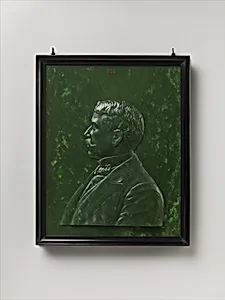
法國 十九世紀 玉畢紹普半身肖像|Portrait of Heber R. Bishop
Medium
Jade (nephrite)
Dimensions
H. 10 in. (25.4 cm); W. 8 in. (20.3 cm)
Classification
Jade
Culture
France
Department
Asian Art
Museum
Metropolitan Museum of Art, New York, NY
Credit
Gift of Heber R. Bishop, 1902
Accession Number
02.18.800
Rights
Public Domain
Tags
Art Historical Context
This exquisite jade portrait bust captures Heber R. Bishop, a prominent American collector, in a dignified profile view. Carved in 1898 by the Berquin-Varang Workshop in France, it exemplifies late 19th-century European of nephrite jade—a tough, translucent stone traditionally associated with Chinese artistry. Measuring 10 by 8 inches, the half-length sculpture showcases Bishop's thoughtful expression and detailed attire, rendered with remarkable precision despite jade's resistance to carving. The artwork's historical significance lies in its fusion of Western portraiture traditions with Eastern materials. French workshops like Berquin-Varangoz gained renown for importing high-quality nephrite from Asia and transforming it into realistic sculptures, bridging cultures at a time when global trade fueled artistic innovation. Techniques involved meticulous polishing and intricate incising to achieve lifelike textures, from the subtle veins in the stone to the crisp lines of Bishop's collar. Gifted to the Metropolitan Museum of Art by Bishop himself in 1902, this piece anchors his landmark jade donation, highlighting his passion for the medium. Displayed in the Asian Art department, it invites visitors to ponder the global exchanges that shaped modern collecting.
About the Artist
Berquin-Varangoz Workshop
**Berquin-Varangoz Workshop** was a distinguished French lapidary atelier specializing in intricate hardstone carvings, particularly in nephrite jade. Founded in 1875 in Bondy, northeast of Paris, by Mr. Varangoz, a skilled bronzier, the workshop passed to his daughter, the widow Berquin, around 1900, who continued and expanded its operations under the combined name. The workshop excelled in the ...