
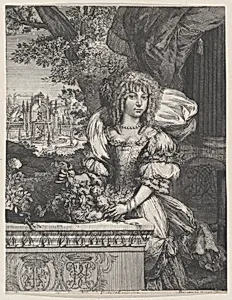
Portrait of Mary Stuart
Medium
Etching
Dimensions
sheet: 10 13/16 x 8 5/16 in. (27.4 x 21.1 cm)
Classification
Prints
Department
Drawings and Prints
Museum
Metropolitan Museum of Art, New York, NY
Credit
The Elisha Whittelsey Collection, The Elisha Whittelsey Fund, 1949
Accession Number
49.95.746
Rights
Public Domain
Tags
Art Historical Context
This etching, *Portrait of Mary Stuart*, the regal poise of Mary II, Queen of England, Ireland, Scotland, and Wales (1662–1694), as rendered by the prolific Dutch artist Romeyn de Hooghe. Created undated but characteristic of de Hooghe's late 17th-century Baroque style the print measures 10 13/16 x 8 5/16 inches and exemplifies etching's precision—acid biting into a metal plate to produce intricate lines that convey texture, expression, and fine details like lace or jewelry. De Hooghe, renowned for his satirical and propagandistic works, here elevates royal portraiture through dynamic shading and expressive mark-making. Mary II's image held immense cultural weight during her joint reign with William III after the Glorious Revolution of 1688, symbolizing Protestant stability amid political upheaval. As a reproducible print rather than a unique painting, it democratized access to royal iconography, circulating her likeness across Europe to foster loyalty and prestige. Housed in the Metropolitan Museum of Art's Drawings and Prints department, part of The Elisha Whittelsey Collection (acquired 1949), this work highlights the era's fusion of artistry and politics, inviting us to ponder how etchings shaped public perceptions of power.
About the Artist
Romeyn de Hooghe|Mary II, Queen of England, Ireland, Scotland and Wales · 1645–1708
Romeyn de Hooghe (1645-1708) was a Dutch Baroque engraver, draughtsman, and political satirist who became the most prolific and versatile graphic artist of the Dutch Republic in the late seventeenth century. Born in Amsterdam, he rose to become one of early modern Europe's most important printmakers and a pioneering master of political satire. De Hooghe's significance extends far beyond his techn...