
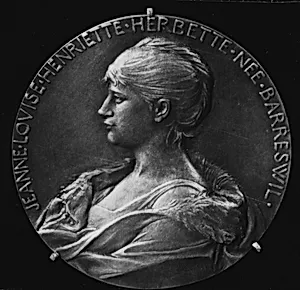
Portrait of Mme. Herbette
1887
Medium
Bronze, cast
Dimensions
Diameter: 2 11/16 in. (68 mm)
Classification
Medals and Plaquettes
Culture
French
Department
European Sculpture and Decorative Arts
Museum
Metropolitan Museum of Art, New York, NY
Credit
Gift of Samuel P. Avery, 1893
Accession Number
93.10.28
Rights
Public Domain
Tags
Art Historical Context
Nestled in the Metropolitan Museum of Art's European Sculpture and Decorative Arts collection, *Portrait of Mme. Herb* (1887) is a bronze cast medal by the renowned French artist Louis-Oscar Roty Measuring just 2 11/16 inches (68 mm) in diameter this intimate plaquette captures the elegant profile of its subject, a woman rendered with graceful poise. Roty, a master of the medallic arts during the late 19th century, exemplifies the French tradition of finely crafted portraits that blended classical influences with emerging modern sensibilities. Crafted in bronze—a durable yet refined medium favored for medals—this piece highlights Roty's exceptional skill in relief sculpture. The profile view, a nod to ancient Roman coins and Renaissance plaquettes, allows for intricate detailing of facial features, hair, and drapery, inviting close inspection. Presented as a gift from Samuel P. Avery in 1893, it reflects the era's fascination with personal commemoration through wearable or displayable art. As part of the Met's celebrated holdings in medals and plaquettes, this work underscores the cultural role of such objects in 19th-century France, where they served as both artistic expressions and tokens of affection or prestige. Visitors are drawn to its timeless elegance, a window into the refined world of Belle Époque portraiture.
About the Artist
Louis-Oscar Roty · 1846–1911
Louis-Oscar Roty, commonly known as Oscar Roty (1846–1911), was born on June 11 in Paris's Belleville neighborhood, the son of a modest schoolmaster. He began his artistic training under Horace Lecoq de Boisbaudran at the Petite École (later the École des Arts Décoratifs), honing his drawing skills, before entering the École des Beaux-Arts in 1864. There, he studied sculpture and medal engraving u...