
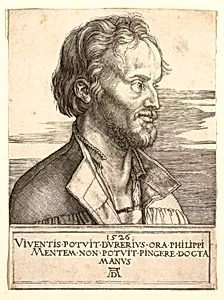
Portrait of Philip Melancthon
Classification
portraits
Department
Smithsonian Collection
Museum
Smithsonian American Art Museum
Credit
Smithsonian American Art Museum
Accession Number
1950-87-8
Rights
Public Domain
About this artwork
Research in Progress
Art Historical Context
Albrecht Dürer’s 1526 *Portrait of Philip Melancthon* captures one of the leading scholars of the Protestant Reformation. Melancthon, a close collaborator of Martin Luther, helped shape Lutheran theology and education across northern Europe. Created just nine years after the posting of the Ninety-Five Theses, the work reflects the intense intellectual and religious ferment of the period, when artists and thinkers alike were reexamining faith, authority, and the individual’s place in society. Dürer, already celebrated across the continent for his precise draftsmanship and innovative printmaking, brought the same sensitivity to portraiture. His images often convey both physical likeness and inner character, blending Northern attention to detail with the emerging ideals of Renaissance humanism. Though the exact medium of this portrait remains unrecorded, its presence in the Smithsonian American Art Museum underscores Dürer’s enduring influence on how we visualize historical figures. Visitors today can appreciate the work as a bridge between medieval devotion and modern individualism, a quiet yet powerful testament to an era of profound change.