
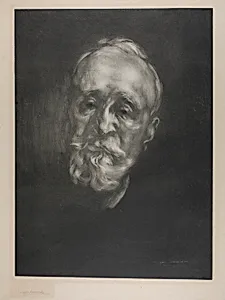
Portrait of Puvis de Chavannes
1897
Medium
Lithograph in black on China paper laid down on heavy buff wove paper
Dimensions
Image: 54.6 × 39.8 cm (21 1/2 × 15 11/16 in.); Sheet: 66 × 48 cm (26 × 18 15/16 in.)
Classification
lithograph
Department
Prints and Drawings
Museum
Art Institute of Chicago
Accession Number
39547
Rights
Public Domain
Art Historical Context
In the Prints and Drawings department of the Art Institute of Chicago resides Eugène Carrière's *Portrait of Puvis de Chavannes* (1897), a striking lithograph that captures the essence of late 19th-century French artistic circles. Carrière, a master of Symbolist portraiture, depicts Pierre Puvis de Chavannes, the revered muralist and Symbolist painter whose dreamlike wall decorations adorned public buildings across France. Created just a year before Puvis's death, this work reflects the mutual admiration between two giants of the fin-de-siècle art world, where Symbolism emphasized mood and mystery over realism. Rendered in black ink on delicate China paper— prized for its smooth texture and ability to hold fine details—then laid down on sturdy buff wove paper for preservation, the lithograph measures an imposing image of 54.6 × 39.8 cm. Lithography, Carrière's favored medium, allowed for rich tonal gradations through the greasy crayon-on-stone process, producing velvety shadows and subtle contours that evoke introspection. This technique democratized access to high art, bridging elite painting with affordable prints. As a testament to artistic legacy, the portrait underscores the camaraderie of Symbolists amid Paris's vibrant cultural scene, inviting visitors to ponder the blurred lines between artist and muse in an era of innovation and transition.
About the Artist
Eugène Carrière · 1849–1906
Eugène Carrière (1849–1906) was a French painter whose deeply personal and atmospheric canvases made him one of the most distinctive voices of the Symbolist generation. Born in Gournay-sur-Marne, Carrière trained at the École des Beaux-Arts in Paris under Alexandre Cabanel, though he quickly moved beyond the academic conventions he encountered there, forging an intensely individual manner that owe...