
Portrait of Rudolph II
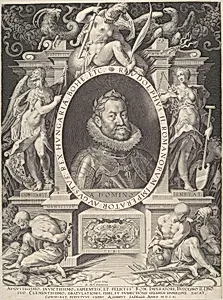
Medium
Engraving
Dimensions
Sheet: 13 1/4 x 9 7/8 in. (33.7 x 25.1 cm)
Classification
Prints
Department
Drawings and Prints
Museum
Metropolitan Museum of Art, New York, NY
Credit
The Elisha Whittelsey Collection, The Elisha Whittelsey Fund, 1951
Accession Number
51.501.6469
Rights
Public Domain
Tags
Art Historical Context
This striking engraving captures the likeness of Holy Roman Emperor Rudolph II, a renowned patron of the arts and sciences during the late Renaissance. Created in 1603 by Aegidius Sadeler II after a design by Hans von Aachen, the portrait reflects the sophisticated court culture of Prague, where both artists served. Von Aachen, a leading Mannerist painter, specialized in elegant, allegorical portraits, while Sadeler’s masterful engraving technique translated these compositions into widely distributable prints. The work’s inclusion of an eagle underscores Rudolph’s imperial authority, evoking both the Habsburg dynasty and the symbolic bird of the Holy Roman Empire. As an engraving, this piece exemplifies the important role of reproductive prints in the early seventeenth century, allowing the emperor’s image to reach beyond the court to collectors and scholars across Europe. Measuring just over thirteen inches tall, the sheet demonstrates Sadeler’s precise line work and subtle tonal modeling, hallmarks of Northern European printmaking at its height. Today it stands as a vivid reminder of Rudolph II’s cultural legacy and the collaborative artistry that preserved it.
About the Artist
Aegidius Sadeler II|Hans von Aachen · 1568–1629
Netherlandish, Antwerp 1568–1629 Prague