
The Emperor Rudolph II
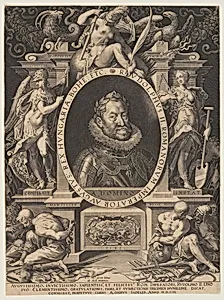
Medium
Engraving on ivory laid paper
Dimensions
Sheet (trimmed): 33.5 × 25 cm (13 1/4 × 9 7/8 in.)
Classification
Department
Prints and Drawings
Museum
Art Institute of Chicago
Accession Number
268314
Rights
Public Domain
Art Historical Context
Welcome to the Art Institute of Chicago's Prints and Drawings collection, where you'll find *The Emperor Rudolph II* (1603), a masterful engraving by Flemish artist Aegidius Sadeler. Sadeler, a prominent member of the celebrated Sadeler family of engravers, crafted this portrait during his time at the imperial court in Prague. Holy Roman Emperor Rudolph II (2–1612), depicted here in regal attire, was a passionate patron of the arts, amassing one of Europe's greatest collections of paintings, sculptures, and scientific curiosities. Engraved on luxurious ivory laid paper—a smooth, high-quality support ideal for capturing intricate details—this 33.5 × 25 cm sheet exemplifies the precision of intaglio printmaking. Sadeler's technique involved incising fine lines into a metal plate, allowing for rich tonal contrasts and lifelike textures in Rudolph's fur-lined robes and stern gaze. As a reproductive print, it helped disseminate the emperor's image across Europe, blending Northern Mannerist elegance with portraiture's diplomatic power. This work offers a window into Rudolph's enigmatic era, marked by artistic fervor amid political turmoil. Marvel at how Sadeler's skill immortalized a ruler whose court fostered geniuses like Arcimboldo and Kepler—truly a gem for history lovers!
About the Artist
Aegidius Sadeler, II · 1570–1629
Aegidius Sadeler II was born in Antwerp around 1570 into the most distinguished printmaking dynasty of the sixteenth century. The Sadeler family — spanning Jan I, Raphael, and Aegidius I — dominated the European print trade from their Flemish base, and Aegidius II was trained by his uncle Jan Sadeler I, under whom he was listed as a pupil in the records of the Antwerp Guild of St. Luke in 1585. He...