
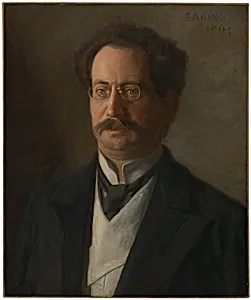
Portrait of Samuel Myers
Classification
Painting
Department
Smithsonian Collection
Museum
Smithsonian American Art Museum
Credit
Hirshhorn Museum and Sculpture Garden, Smithsonian Institution, Washington, DC, Gift of Joseph H. Hirshhorn, 1966
Accession Number
66.1493
Rights
Public Domain
About this artwork
Jh Purchased From Knoedler & Co., Inc., M., New York 1961
Art Historical Context
Thomas Eakins, one of America's foremost realist painters, created *Portrait of Samuel Myers* 1904, late in his prolific career. Born in Philadelphia in 1844, Eakins was renowned for hisinching commitment to anatomical accuracy and psychological depth in portraits, often drawing from background in medical illustration and photography. This painting exemplifies his signature style, capturing the sitter with a direct, lifelike intensity that bridged 19th-century academic traditions with modern realism. Painted during Eakins' final productive years—after controversies over nudity in his teaching at the Pennsylvania Academy of the Fine Arts—the work reflects the era's shift toward personal, introspective portraiture in American art. Though the medium is unspecified, Eakins favored oil on canvas for its rich textures, allowing subtle modeling of light and form to convey character. Acquired by Joseph H. Hirshhorn from New York dealer Knoedler & Co. in 1961 and gifted to the Smithsonian Institution in 1966, the portrait now resides in the Smithsonian American Art Museum's collection (on view through the Hirshhorn Museum and Sculpture Garden). It stands as a testament to Eakins' enduring influence on American realism, inviting visitors to ponder the humanity behind the gaze.