
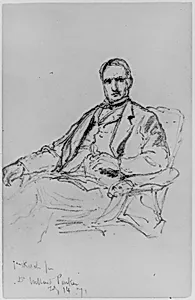
Portrait of Willard Parker, 1871 (from Sketchbook)
ca. 1870
Medium
Graphite on paper
Dimensions
5 1/2 x 8 3/4 in. (14 x 22.2 cm)
Classification
Drawing
Culture
American
Department
The American Wing
Museum
Metropolitan Museum of Art, New York, NY
Credit
Gift of S.B. Luyster, 1936
Accession Number
36.124gg verso
Rights
Public Domain
Tags
Art Historical Context
In the American Wing of the Metropolitan Museum Art, Daniel Huntington's *Portrait of Willard Parker,1871 (from Sketch)* offers a glimpse into 19th-century artistic practice. Created around 1870 in graphite on paper, this intimate 5½ x 8¾-inch sketch captures the likeness of Willard Parker, a prominent New York surgeon known for his contributions to medical education and surgery. Donated in 1936 by S.B. Luyster, it the personal, preparatory nature of sketchbook studies, where artists like Huntington honed their skills away from the studio's formality. Huntington, a leading American portraitist of his era, worked in a realistic style influenced by academic traditions, often depicting notable figures from politics, science, and culture. Graphite's versatility—its soft, precise lines ideal for quick modeling of form and expression—made it perfect for such portable works. This sketch likely served as a study for a larger painting, revealing the artist's keen observation of character and anatomy amid the post-Civil War boom in American portraiture. As a cultural artifact, it reflects Gilded Age reverence for intellectual leaders like Parker, bridging art and medicine in everyday creativity. Visitors will appreciate its unpretentious charm, a window into the thoughtful process behind grand canvases.
About the Artist
Daniel Huntington · 1816–1906
Daniel Huntington (1816–1906) was born into a prominent New York family on October 4, 1816, descending from distinguished New England lineage. His early education began at age fourteen at Smith's Academy in New Haven, followed by Yale College, where he studied with Samuel F. B. Morse, the inventor, artist, and president of the National Academy of Design, in 1835. After a disciplinary incident invo...