
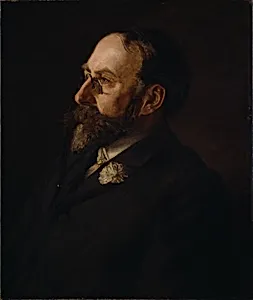
Portrait of William Merritt Chase
Classification
Painting
Department
Smithsonian Collection
Museum
Smithsonian American Art Museum
Credit
Hirshhorn Museum and Sculpture Garden, Smithsonian Institution, Washington, DC, Gift of Joseph H. Hirshhorn, 1966
Accession Number
66.1486
Rights
Public Domain
About this artwork
Hirschl & Adler Galleries, New York, to 1959
Art Historical Context
Thomas Eakins painted portrait of fellow artist William Chase around 189, capturing one of the leading figures in late nineteenth-century American art. Eakins, a Philadelphia native renowned for his unflinching realism, often turned his attention to fellow painters and intellectuals, using portraiture to explore character and professional identity. The work now resides in the Smithsonian’s Hirshhorn Museum and Sculpture Garden, a gift that places it among the nation’s premier holdings of modern American art. Eakins approached portraiture with scientific precision and psychological insight, favoring natural light and careful observation over flattery. Though the exact medium remains unrecorded, the painting reflects his lifelong commitment to truthful representation. Chase, by contrast, was celebrated for his lively impressionist brushwork and elegant society portraits; seeing him through Eakins’s more sober lens offers a fascinating dialogue between two distinct artistic temperaments of the era. This meeting of realist and impressionist sensibilities underscores the rich diversity of American painting at the turn of the twentieth century. The portrait stands as both a personal tribute and a document of artistic exchange, inviting viewers to consider how painters saw one another and their shared profession.