
Portret van August II van Saksen
1654
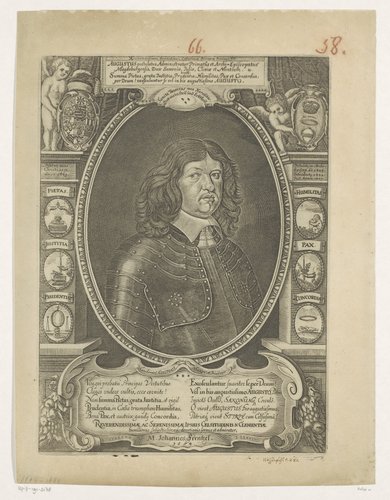
Medium
engraving
Dimensions
303; 220
Rights
Public Domain
About this artwork
height 303 mm x width 220 mm
Art Historical Context
Behold Johann Dürr's *Portret van August II vanen* (1654), a finely executed engraving measuring 303 mm high by 220 mm wide. This mid-17th-century portrait captures the likeness of August II, Elector of Saxony, in a medium that was revolutionary for its time. Engraving, where intricate lines are incised into a metal plate inked, and pressed onto paper, allowed for multiple impressions, making elite imagery accessible beyond the court. Created during the Baroque era, just after the devastating Thirty Years' War (1618–1648), the work reflects Saxony's resurgence as a key German electorate. Dürr, a skilled German printmaker active in the period, employed precise hatching and cross-hatching techniques to convey texture, depth, and regal authority—hallmarks of portrait engravings that served diplomatic and commemorative purposes. Such prints were vital for propagating the ruler's image across Europe, fostering loyalty and prestige. Though modest in scale, this piece exemplifies how engraving democratized art, bridging the gap between palace halls and scholarly collections. A testament to 17th-century craftsmanship, it invites us to ponder the enduring power of a single, replicated gaze.
About the Artist
Johann Dürr · 1600–1663
Johann Dürr (1600–1663) was a German copperplate engraver who worked primarily in Weimar during the mid-17th century, producing prints for court and scholarly patrons during the tumultuous period of the Thirty Years' War. Born in 1600, Dürr's career spanned one of the most devastating periods in German history, when religious conflict and military campaigns brought widespread destruction to German...