
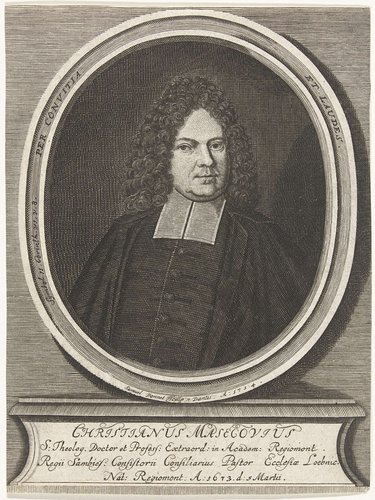
Portret van de protestantse theoloog Christian Masecovius
1714
Medium
engraving
Dimensions
190; 143
Rights
Public Domain
About this artwork
height 190 mm x width 143 mm
Art Historical Context
In the quiet elegance of 18th-century Dutch printmaking, Samuel Donnet's *Portret van de protestantseoloog Christian Masecov* (1714) captures the dignified likeness of a prominent Protestant theologian. Created as an engraving measuring just 190 mm high by 143 mm wide, this intimate portrait likely served as a scholarly tribute, circulating among intellectuals and clergy to honor Masecovius's legacy Donnet, a skilled Dutch engraver active in the early 1700s, exemplifies era's precision in reproductive prints, which made prestigious images accessible beyond oil paintings. Engraving, a meticulous intaglio technique involving incised metal plates inked and pressed onto paper, allowed for fine details in facial features, attire, and symbolic elements often seen in theologian portraits—evoking piety and intellectual gravitas. Produced over four decades after Masecovius's death (he lived 1597–1672 and taught at the University of Franeker), this work reflects the Netherlands' enduring Reformed tradition, where visual memorials reinforced Protestant values amid the post-Reformation cultural landscape. A gem for print enthusiasts, it highlights how small-scale engravings democratized portraiture in the Baroque age.
About the Artist
Samuel Donnet · 1699–1734
Samuel Donnet (ca. 1698–1734) emerged as a skilled copper engraver in the bustling Hanseatic city of Danzig (present-day Gdańsk), where he was active from 1699 until his death. Baptized on October 10, 1698, in the city's Frisian Church—a hub for Dutch and Flemish immigrants—he married on January 6, 1699, and fathered a son named Samuel. His brother, Johann Donnet, was also a copper engraver who ou...