
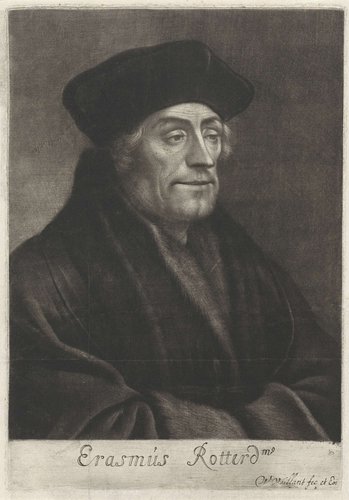
Portret van Desiderius Erasmus
1658 - 1677
Medium
paper
Dimensions
195; 135
Rights
Public Domain
About this artwork
mezzotint
Art Historical Context
**Portrait of Desiderius** by Wallerant Vaillant (. 1658–1677) captures the likeness of the renowned Renaissance humanist and scholar Desiderius Erasmus of Rotterdam on a modest sheet of paper measuring × 135 mm. Vaillant, a Dutch engraver active during the Golden Age, homage to Erasmus, whose writings on philosophy, theology, and education profoundly shaped European thought in the 16th century This intimate portrait reflects the era's admiration for intellectual giants, often immortalized print to reach wide audiences. The artwork's standout feature is its mezzot technique, pioneered by Vaillant around 1658. Unlike traditional engraving's sharp lines, mezzotint begins with a roughened copper plate that produces velvety blacks and subtle gradations, mimicking the tonal richness of oil paintings. This innovation allowed for unprecedented realism in portraits, making fine art accessible beyond elite patrons. Vaillant's mastery shines in the soft shading and depth, turning a small print into a luminous tribute. Culturally, this piece bridges Renaissance humanism with 17th-century Dutch artistry, highlighting printmaking's role in preserving legacies. Visitors will appreciate how Vaillant's technical breakthrough influenced artists like Rembrandt, democratizing portraiture in an age of discovery and debate.
About the Artist
Wallerant Vaillant · 1623–1677
Wallerant Vaillant (1623-1677) was a French-born Dutch Golden Age painter and printmaker who pioneered the mezzotint technique in printmaking. Born in Lille on May 30, 1623, he died in Amsterdam on August 28, 1677, leaving behind a significant legacy as both a portraitist and innovator in graphic arts. Vaillant holds a distinguished place in art history as one of the first professional artists to...