
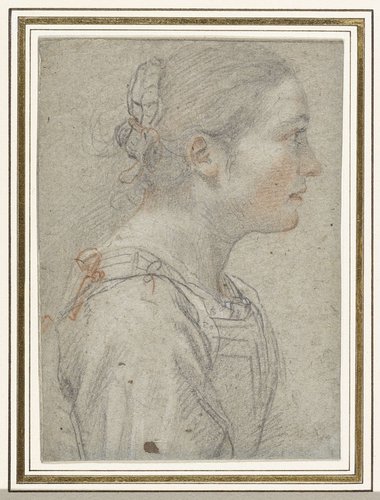
Portret van een onbekende jonge vrouw
1620 - 1629
Medium
paper
Dimensions
99; 138
Rights
Public Domain
About this artwork
zwart, rood en wit krijt op grijs papier
Art Historical Context
**Portrait of an Unknown Young** by Giovanni Mannozzi (c 1620–1629) is a delicate chalk drawing that captures the subtle beauty of its unidentified subject. Created during the Baroque era in Italy, this portrait measures just 138 x 99 mm, making it a gem among preparatory sketches or standalone studies prized by collectors of the time. Mannozzi, aentine artist influenced by Caravaggio's dramatic tenebrism, often explored portraiture alongside religious scenes, blending realism with emotional depth. The work employs a masterful three-chalk technique—black, red, and white on gray prepared paper—a hallmark of 17th-century draftsmanship. This method allowed artists like Mannozzi to achieve lifelike modeling: black for shadows, red for warm mid-tones, and white for luminous highlights, evoking the soft play of light on flesh. The gray ground provides a neutral base, enhancing the three-dimensionality and immediacy of the young woman's gaze, which draws viewers into a moment of quiet vulnerability. Such drawings held cultural significance as affordable alternatives to oil portraits, serving artists' studios, patrons' albums, or academies. Mannozzi's piece reflects Baroque interest in human emotion and naturalism, offering a window into early 17th-century Italian life. Today, it reminds us of the era's reverence for the human form in its most unadorned state.
About the Artist
Giovanni Mannozzi · 1592–1636
Giovanni da San Giovanni, born Giovanni Mannozzi on March 20, 1592, in San Giovanni Valdarno, emerged as one of the most vibrant and idiosyncratic painters of early Baroque Florence. He trained under the esteemed Matteo Rosselli, a leading figure in the city's artistic scene, and honed his skills in architectural perspective with Giulio Parigi, whose influence imbued his work with dynamic spatial ...