
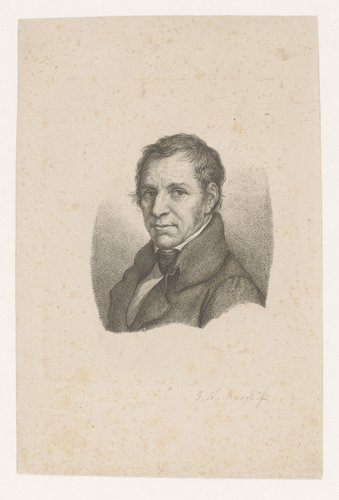
Portret van een onbekende man
1800 - 1870
Medium
etching
Dimensions
138; 165
Rights
Public Domain
About this artwork
collector's mark: Lugt 2228
Art Historical Context
"Portret van een onende man" (Portrait of an Unknown Man) a delicate etching by Johann Nepomuk Mel, a 19th-century German engr active during the period spanning 1800 to 1870. Measuring just 165mm by 138mm, this intimate portrait captures the essence of anonymous subject through fine lines and subtle shading, typical of etching's precision. Muxel's work reflects the era's fascination with portraiture, where printmaking allowed for widespread dissemination of likenesses among the growing middle class and collectors. Etching, the chosen medium, involves coating a metal plate with acid-resistant ground, scratching designs into it, and immersing it in acid to etch the lines. This technique lent itself to Muxel's detailed renderings, producing rich tonal contrasts and textures that mimic painting. Produced in the Romantic and early Realist periods, such prints were prized for their affordability compared to oil portraits, bridging fine art and popular culture. Bearing the collector's mark Lugt 2228—associated with the esteemed 19th-century French collector Eugène Dutuit—this piece highlights its journey through prestigious hands. Dutuit's mark underscores the artwork's enduring appeal, inviting us to ponder the unknown man's story amid 19th-century Europe's vibrant printmaking tradition.
About the Artist
Johann Nepomuk Muxel · 1790–1870
Johann Nepomuk Muxel (1790-1870) was a German painter and etcher who devoted much of his career to documenting the celebrated art collection of Eugene de Beauharnais, Duke of Leuchtenberg, through meticulous reproductive prints. Born on April 20, 1790, in Munich and dying on May 17, 1870, also in Munich, Muxel's eighty-year life spanned a crucial period in European art history when reproductive pr...