
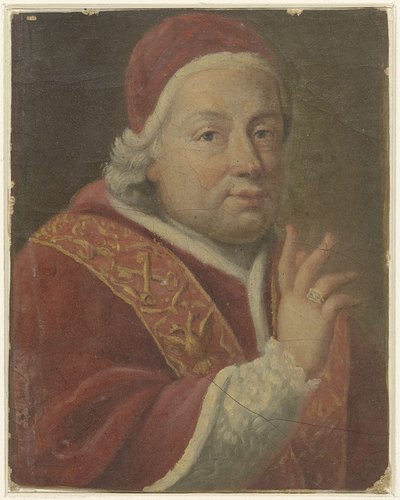
Portret van een paus
1700 - 1800
Medium
brush
Dimensions
136; 107
Rights
Public Domain
About this artwork
penseel in olieverf in kleuren
Art Historical Context
**Portrait of a Pope** This intimate 18th-century oil painting on panel, titled *Portret van een pa*, captures the solemn likeness of an unidentified pope. Created anonymously between 1700 and 1800, it measures just 136 × 107 mm—small enough to fit in the palm of your hand. Such miniature portraits were prized in Europe for personal devotion, travel, or as affordable copies grander ecclesiastical images, reflecting the era's blend of religious piety and emerging portraiture trends. The artwork's medium—"penseel in olieverf in kleuren," or brushwork in colorful oil paint—highlights skilled handling of translucent glazes and fine detailing typical of small-scale oil portraits. These techniques allowed anonymous artists, often from workshops, to mimic the grandeur of larger papal portraits by masters like Raphael or Titian. During the 18th century, amid Enlightenment shifts and Catholic Counter-Reformation echoes, such images reinforced papal authority and spiritual presence in private homes. Though the pope's identity remains a mystery, the portrait's survival speaks to its cultural role: a tangible link to Vatican power in an age of political intrigue. Imagine carrying this tiny icon as a faithful traveler—its vivid colors and dignified pose still evoke timeless reverence today.
About the Artist
anonymous
In the vast tapestry of art history, "Anonymous" stands not as a singular individual but as a collective designation for countless unidentified creators whose works have endured across millennia. These artists, spanning prehistoric cave painters to medieval illuminators and folk craftsmen, produced the foundational layers of human visual culture. Prior to the Renaissance, when individual fame emer...