
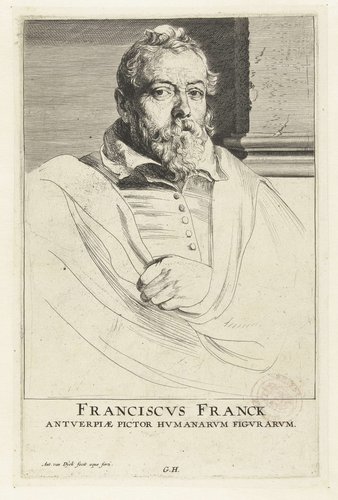
Portret van Frans Francken I
1645 - 1646
Medium
etching
Dimensions
247; 160
Rights
Public Domain
About this artwork
plaatrand: hoogte 247 mm x breedte 160 mm
Art Historical Context
Anthony van Dyck's *Portret van Frans Francken I* (1645–1646) is a striking etching capturing the likeness of Frans Francken I, a prominent Flemish painter from the late 16th century known for his intricate cabinet pictures and genre scenes. Though dated after van Dyck's death in 1641, this print likely stems from his renowned *Iconography* series—a collection of over 100 portraits of artists, scholars, and nobles that van Dyck began etching around 1630. Produced by his workshop or publishers, it exemplifies the Baroque master's ability to convey dignity and character in print form. As a leading figure of Flemish Baroque art and court painter to Charles I of England, van Dyck elevated portraiture with fluid lines and psychological depth. This etching, measuring 247 mm high by 160 mm wide (plate mark), showcases his etching technique: delicate, velvety lines that mimic the luminosity of his oil paintings, making prints accessible to a wider audience beyond elite patrons. The *Iconography* preserved the faces of Europe's cultural elite, influencing later printmakers like Rembrandt. Today, this modest yet masterful work highlights the interconnected world of Antwerp's artistic dynasty—the Franckens—and van Dyck's legacy in democratizing portraiture through innovative printmaking. A testament to 17th-century cultural reverence, it invites visitors to ponder the enduring bond between artist and subject.
About the Artist
Anthony van Dyck · 1599–1641
Sir Anthony van Dyck (1599-1641) was a Flemish Baroque artist who revolutionized portrait painting and became the most influential court painter in 17th-century England. Born in Antwerp as the seventh of twelve children to a prosperous silk merchant, van Dyck displayed extraordinary artistic talent from childhood. He trained under Hendrick van Balen before joining Peter Paul Rubens's workshop as a...