
Portret van Jacobus II van Engeland
1662 - 1726
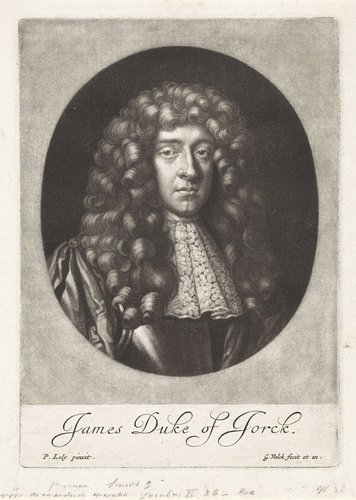
Medium
paper
Dimensions
196; 140
Rights
Public Domain
About this artwork
mezzotint
Art Historical Context
This mezzotint portrait by Dutch printmaker Gerard Valck captures James II of England during his lifetime (1633–1701). Created between 1662 and 1726 on paper measuring roughly 20 by 14 centimeters, the work exemplifies the tonal richness of mezzotint, a technique Valck helped popularize in the Netherlands. By rocking a serrated tool across the copper plate to create thousands of tiny dots, the artist could produce deep blacks and subtle gradations that mimic the soft effects of painting—qualities especially prized for royal likenesses in the late seventeenth century. James II’s reign (1685–1688) was marked by religious tension and political upheaval, culminating in the Glorious Revolution that forced his exile. Valck’s print, likely based on an earlier painted source, served both as a commemorative image and a means of circulating the king’s likeness across Europe at a time when printed portraits shaped public perception of monarchy. The intimate scale invites close viewing, allowing modern audiences to appreciate the delicate balance of formality and humanity conveyed through the medium’s velvety textures. As a Dutch artist working in Amsterdam, Valck contributed to the flourishing market for affordable yet refined prints that brought European courts into private homes. This example remains a vivid record of both technical innovation and the turbulent Stuart era.
About the Artist
Gerard Valck · 1652–1726
Gerard Valck (1652–1726) was a Dutch engraver, publisher, and cartographer whose career bridged the 17th-century Dutch Golden Age and the 18th-century Enlightenment. Born on September 30, 1652, in Amsterdam to a silversmith father, and dying on October 21, 1726, Valck played a crucial role in introducing and developing mezzotint printmaking in England while also establishing a significant publishi...