
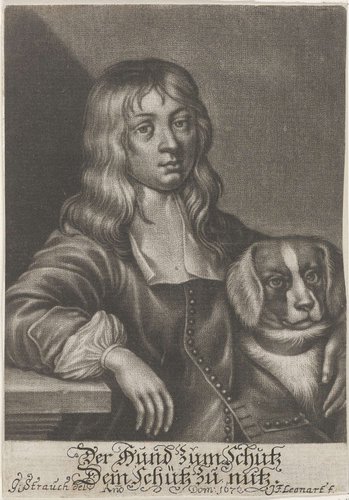
Portret van Joh. Baltas. Schütz
Medium
engraving
Dimensions
93; 132
Rights
Public Domain
About this artwork
mezzotint en gravure
Art Historical Context
"Portret van Joh. Baltas. Schütz" is a finely crafted engraving by Johann Friedrich Leonard, dated 1672. This intimate portrait, measuring just 132mm high by 93mm wide, captures the likeness of Joh. Baltas. Schütz, likely a figure of note in 17th-century Europe. Created during the Baroque era, such small-scale prints were popular for their portability, allowing admirers to own and display images of prominent individuals in private collections or studies. The artwork employs engraving techniques, specifically noted as "mezzotint en gravure." Mezzotint, a revolutionary method pioneered in the mid-1600s, involves roughening a copper plate to hold ink in tonal gradations, producing rich, velvety shadows and subtle highlights ideal for portraiture. Unlike traditional line engravings, this approach allowed Leonard to achieve a painterly depth in a monochromatic medium, making the image remarkably lifelike despite its modest size. As a product of the Dutch Golden Age's printmaking tradition, this piece highlights the era's mastery of reproductive art, disseminating portraits across social circles. Visitors will appreciate its technical sophistication—a testament to how engravers like Leonard elevated print to high art, bridging painting and mass appeal.
About the Artist
Johann Friedrich Leonard · 1630–1690
Johann Friedrich Leonhard (also spelled Leonard or Leonart, 1633–1680/87) was a German copperplate engraver and early practitioner of mezzotint who worked during the Baroque period, creating portraits and reproductive engravings after works by other artists. Though documentation of his life remains limited, his surviving works demonstrate mastery of engraving techniques and participation in the ne...