
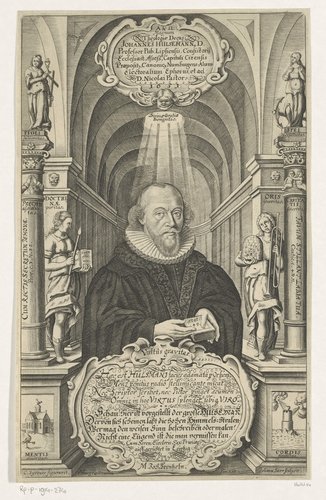
Portret van Johann Hülsemann
1651
Medium
engraving
Dimensions
168; 270
Rights
Public Domain
About this artwork
Portret in architecturale omlijsting, met onder in cartouche een lofdicht in het Latijn. Omlijsting versierd met christelijke symboliek.
Art Historical Context
"Portret van Johann Hüemann" is a striking 1651 engraving by Johann Dürr, measuring 270mm by 168mm. This portrait captures the likeness of Johann Hülsemann a prominent Lutheran theologian of the era, framed within an elaborate architectural surround—a technique common in 17th-century printmaking evoke grandeur and permanence, much like a painted oil on canvas. Dürr's mastery of engraving, an intaglio process where lines are incised into a metal plate and inked for detailed impressions, allowed for intricate reproductions that could be distributed, making scholarly portraits accessible beyond elite circles. At the base, a cartouche holds a Latin laudatory poem (lofdicht), a poetic tribute typical of Baroque-era honors for intellectuals and clergy. The architectural frame is richly adorned with Christian symbols—perhaps crosses, doves, or anchors of faith—underscoring Hülsemann's pious legacy and the era's intertwining of portraiture with religious devotion. This decorative style reflects the Baroque movement's emphasis on drama, ornament, and spiritual depth. Created amid Europe's post-Reformation tensions, the print highlights the cultural role of engravings in preserving the images and reputations of reformers. Dürr's work exemplifies how such portraits bridged art and theology, inviting viewers to reflect on faith and intellect in a turbulent age. A testament to meticulous craftsmanship, it remains a window into 17th-century scholarly reverence.
About the Artist
Johann Dürr · 1600–1663
Johann Dürr (1600–1663) was a German copperplate engraver who worked primarily in Weimar during the mid-17th century, producing prints for court and scholarly patrons during the tumultuous period of the Thirty Years' War. Born in 1600, Dürr's career spanned one of the most devastating periods in German history, when religious conflict and military campaigns brought widespread destruction to German...