
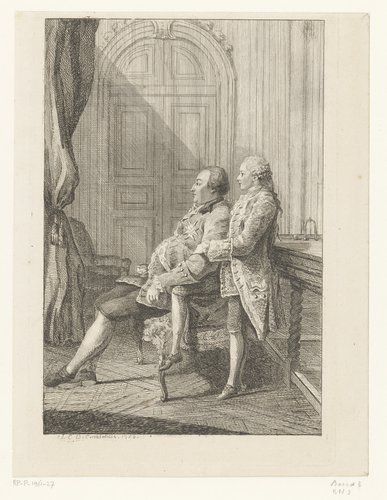
Portret van Lodewijk Filips I van Orléans en zijn zoon Lodewijk Filips II van Orléans
Medium
etching
Dimensions
297; 228
Rights
Public Domain
About this artwork
Dubbelportret van Lodewijk Filips I van Orléans en zijn zoon Lodewijk Filips II van Orléans in de koninklijke biljartkamer.
Art Historical Context
Step into the opulent world of 18th-century French aristocracy with *Portret van Lodewijk Filips I van Orléans en zijn zoon Lodewijk Filips II van Orléans*, an etching by Louis de Carmontelle from 1759. This double portrait captures a tender father-son moment in the royal billiard room, a space evoking leisure and privilege amid the grandeur of the Ancien Régime. Measuring 297mm by 228mm, the work showcases Carmontelle's skill in etching—a precise intaglio technique where acid bites into a metal plate to create fine lines, allowing for detailed reproductions of intimate scenes that could be widely shared among the elite. Louis Philippe I, Duke of Orléans, was a prominent noble and influential figure during Louis XV's reign, later ascending as King of the French in 1830. His son, Louis Philippe II, would inherit the title and play key roles in revolutionary politics. Carmontelle, a versatile artist, draughtsman, and court insider, excelled at portraying the beau monde in candid, lively vignettes, blending formality with everyday humanity. This piece offers a glimpse into Orléans family dynamics, highlighting their status through the billiard room's refined setting. As an etching, it reflects the era's growing fascination with printmaking for disseminating aristocratic imagery, bridging portraiture and social commentary. A charming window into pre-Revolutionary France, it invites visitors to ponder the personal lives behind political legacies.
About the Artist
Louis de Carmontelle · 1717–1806
**Louis Carrogis Carmontelle** (15 August 1717 – 26 December 1806) was a multifaceted French artist, dramatist, architect, and inventor whose career bridged the worlds of courtly entertainment and innovative visual arts during the Rococo era. Born in Paris to a modest family—his father worked as a bootmaker—he rose through talent and wit from humble origins to serve prominent noble households. He ...