
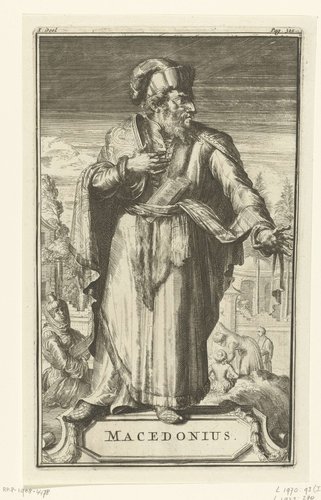
Portret van Macedonius
1701
Medium
etching
Dimensions
270; 160
Rights
Public Domain
About this artwork
height 270 mm x width 160 mm
Art Historical Context
**Portret van Macedonius** is a striking etching by the prolific Dutch artist Romeyn de Hooghe created in 1701. Measuring 270 mm in height by 160 mm in width this intimate portrait exemplifies de Hooghe's mastery of printmaking during the waning years of the Dutch Golden Age. De Hooghe (1645–1708), a versatile figure for his satirical illustrations, book designs, and historical scenes, often turned to etching to capture the likenesses of notable figures with sharp precision and expressive flair. Etching, de Hooghe's preferred medium here, involved coating a copper plate with acid-resistant ground, drawing through it with a needle, and immersing it in acid to etch fine lines—allowing for delicate textures and dynamic shading that brought portraits to life. This technique was revolutionary for its time, enabling affordable reproduction and wide dissemination of images among collectors and scholars in the early 18th century. While the identity of Macedonius remains intriguingly elusive—possibly alluding to a historical or ecclesiastical figure—this work highlights de Hooghe's role in preserving visual records of the era's intellectual and cultural elite. Its compact scale made it ideal for private cabinets of curiosities, inviting close contemplation of the subject's dignified presence amid the Baroque emphasis on realism and ornamentation. A testament to Dutch printmaking's enduring legacy!
About the Artist
Romeyn de Hooghe · 1645–1708
Romeyn de Hooghe (1645-1708) was a Dutch Baroque engraver, draughtsman, and political satirist who became the most prolific and versatile graphic artist of the Dutch Republic in the late seventeenth century. Born in Amsterdam, he rose to become one of early modern Europe's most important printmakers and a pioneering master of political satire. De Hooghe's significance extends far beyond his techn...